.svg)
The Geometry of Morocco
It’s impossible to travel to Morocco without being amazed by the splendor of Islamic decoration. For many visitors, it is one of the main reasons to explore this magical country.
During our visit, Marisa and I were fortunate to be guided by a specialist in Moroccan history and architecture. He led us through cities and palaces, explaining not only the history but also the logic behind the architecture and the patterns that shape it.
This blog explores the structure behind that artistry, the hidden geometry of Moroccan buildings/decorations, and aims to make it understandable as you experience Morocco’s oriental splendor.
The Origins of Islamic Geometry
North African Islamic art developed between the 8th and 9th centuries. Islamic craftsmen began to develop their own intricate style based on symmetry and ingenious patterns. Influences flowed freely between cultures and religions: certain Islamic motifs can be traced back to Byzantine, Sassanian, Greek, and Roman traditions.
These patterns reached extraordinary complexity between the 10th and 12th centuries, inspired by Islamic mathematicians, scientists, astronomers, and philosophers, who shaped the intellectual climate of the Islamic world.
You encounter these patterns everywhere, not only on ceilings, floors, windows, and walls, but also on furniture, fabrics, and lanterns. When lit, the lanterns project breathtaking decorations onto walls and ceilings.
The Moroccan style belongs to the “Western” tradition of Islamic geometric art, developed in Andalusia and the Maghreb between the 10th and 12th centuries under Umayyad rule. Eastern Islamic art can be found in Turkey, Iran, Syria, and Iraq. In Europe, the Alhambra in Granada and the Mezquita in Córdoba are among the most striking examples.
During our visits to palaces and the beautiful Madrasa University, we learned that Moroccan geometric art is based on three major categories:
– the art of the geometric line
– floral and vegetal motifs
– Arabic letters used as ornament through calligraphy
Moroccan Mosaics: Zellijs
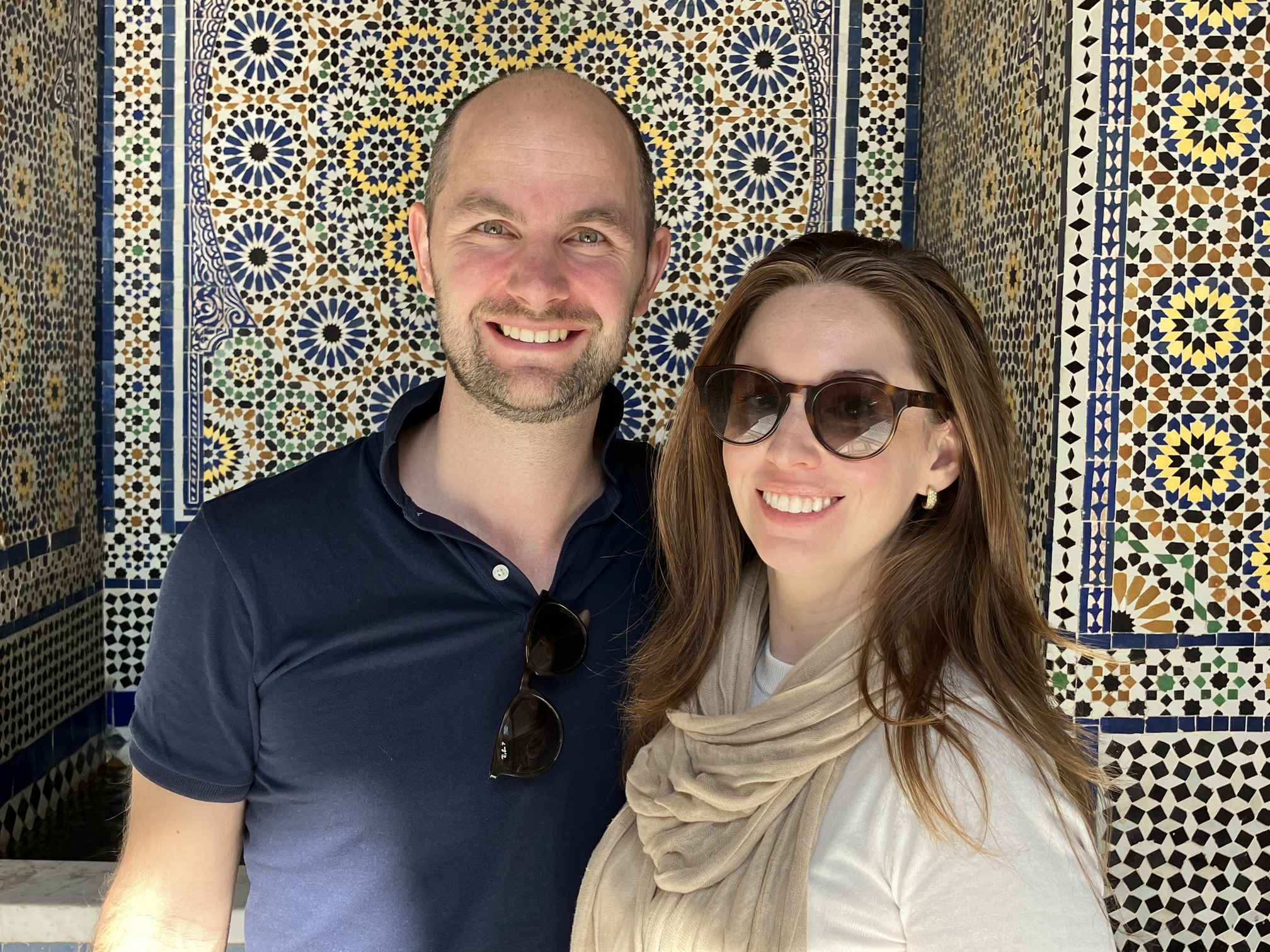
One of the most distinctive features of Moroccan Islamic art is the use of bright and colorful mosaics. Zellijs are an essential and intricate element of Western Islamic art. In the Kasbah Mosque in Marrakech, for example, a turquoise decorative strip forms an astonishing pattern.
In religious and noble buildings, Zellijs appear as large polychrome rosettes constructed with remarkable symmetry. Friezes and calligraphic lines, often quoting Quranic verses, create borders between geometric and arabesque patterns, separating mosaics from plaster.
The colors and patterns draw the eye into intricate, seemingly infinite structures. This visual rhythm creates a harmony that I find deeply pleasing. Zellijs are so iconic that they appear on almost every tourist souvenir.

The Symbolism of Color in Morocco
Moroccan culture has a long tradition of color symbolism. I asked Ahmed to explain the meaning behind the vibrant colors used in mosaics:
White – purity and dignity, reflecting the spiritual “inner light” in Sufi tradition.
Black – ambivalence and mystery, sometimes associated with impurity or bad omens.
Green – the sacred color of Islam, linked to paradise, renewal, and divine blessing.
Blue – infinity and peace, symbolising protection and calmness (one reason Chefchaouen is blue).
Red – strength and protection, bold and powerful, widely used in carpets and clothing.
Yellow – transience and fragility, bringing luminosity but also symbolising decline and fading.
The Geometrical Logic of Islamic Art
Geometrical patterns evolved over time, influenced by foreign cultures and internal tastes, but geometry and symmetry always remained at the core.
Islamic art is based on four primary ornaments:
– geometrical patterns
– floral motifs
– figural motifs (such as animals)
– calligraphy
Patterns often emerge from grids of closed shapes linked by borders, which can be filled with vegetal or figural motifs. When stars are used, the result is an infinite polygonal pattern, a hallmark of Western Islamic art.
Arabesques, composed of intertwining stalks and split leaves, appear fluid but follow strict geometric rules. At the height of craftsmanship, artists attempted to fill every surface so that no background remained visible, a concept described by Gombrich as “amor infinity” and by others as horror vacui, the fear of empty space.
To put it simply: arabesques suggest fluidity, while polygonal patterns suggest geometric rigidity.
The Circle: The Hidden Foundation
The circle is the basis of almost all Islamic geometric patterns. In Islamic art, it represents infinity, unity, and the oneness of God, the ultimate source of all diversity.
Looking at these patterns invites contemplation of infinity, connection, and the relationship between unity and multiplicity. In religious contexts, circles and abstract patterns were also a way to avoid depicting living beings.
Some scholars argue that artisans did not necessarily need advanced mathematical knowledge, since circle-based patterns can be constructed with a ruler and compass. Others, such as Seyyed Hossein Nasr, claim that mathematical thinking, rooted in Pythagorean philosophy, was fundamental to Islamic geometric art.
If you want to experiment with these patterns yourself, all you need is paper, a ruler, and a compass.
Morocco as a Living Palace
We feel incredibly fortunate to travel in a country like Morocco. Traditions and architecture are so well preserved that even new buildings feel timeless, as if you are constantly walking through a palace.
Staying in hotels such as La Sultana and La Mamounia, we felt transported into the magic of past centuries, where tradition and craftsmanship were spectacularly maintained. Combined with the highest standards of hospitality in an already warm and generous culture, our journey through Morocco became one of the most extraordinary trips we have ever experienced.
_Black.png)