.svg)
The History of Hôtel de Crillon
A Palace on Place de la Concorde
Carla, from the Sales-team of Rosewood Hôtel de Crillon, told us the history of Hôtel de Crillon during lunch, and she knew it remarkably well. Louis XV wanted his own grand square, following the example of Louis XIV, and commissioned Ange-Jacques Gabriel to design what became Place Louis XV, now Place de la Concorde. The building at No. 10 was not originally a hotel. It was an aristocratic residence, and that changes the way you look at the rooms. It eventually became a hotel in 1909, but the building had already lived through much of France's complicated history.
Marie Antoinette is part of that history in a very direct way. She had piano lessons at the Crillon, was married on the square, and later received her death sentence there. The same square therefore holds some of the most elegant and some of the darkest moments of her life.
Marie Antoinette and the Piano
For me, as a pianist, the connection with Marie Antoinette is particularly interesting. The hotel identifies the historic salon adjoining the Marie-Antoinette Suite as the place where she is believed to have taken private piano lessons between 1789 and 1792. What I would still like to know is who actually taught her, but after researching this in biographies and other books, it seems to have been lost through time.
Although that detail has not survived clearly, I find it fascinating. During my research into the travels of composers in the 18th and 19th centuries, Marie Antoinette appeared repeatedly. Mozart met her as a child during his grand tour and later wrote about his experiences with the French royal family. There is an incredible story how Revolutionists wanted to throw down her harpsichord (with Boucher's and VanLoo's paintings) from the Tuileries palace but a soldier scolded them, went to them and started playing the revolution songs on the instrument that had seen so many royal parties.
The relationship between musicians and courts was very different from today. Composers performed, taught, dedicated works to patrons and depended heavily on aristocratic and royal support. The Mozarts also wrote about the expectations placed on musicians at court, including the clothes they had to wear and the expense of maintaining the appearance of belonging to a higher social class. Standing in a hotel with a direct musical connection to Marie Antoinette made those stories feel much less distant and created a mental picture that connects to the story.
There is also a Bechstein piano in the bar, another detail I noticed immediately.
.jpg)
The Old Chapel and Lagerfeld
One of my favourite discoveries was the old chapel. A room connecting the two buildings of the hotel has a very intimate feeling and is sometimes used by the guest-experience team for special events. In December, for example, the space is transformed for children with an Around the World in Eighty Days theme. But the detail I really loved was the desk in the suite that was once the chapel. Carla explained its history to us, and I could not stop looking at it. Later, when we visited the Petit Palais, we saw furniture from a similar period, although some of it was in considerably worse condition. It made me appreciate the piece at the Crillon even more.
Then there are the Karl Lagerfeld suites.
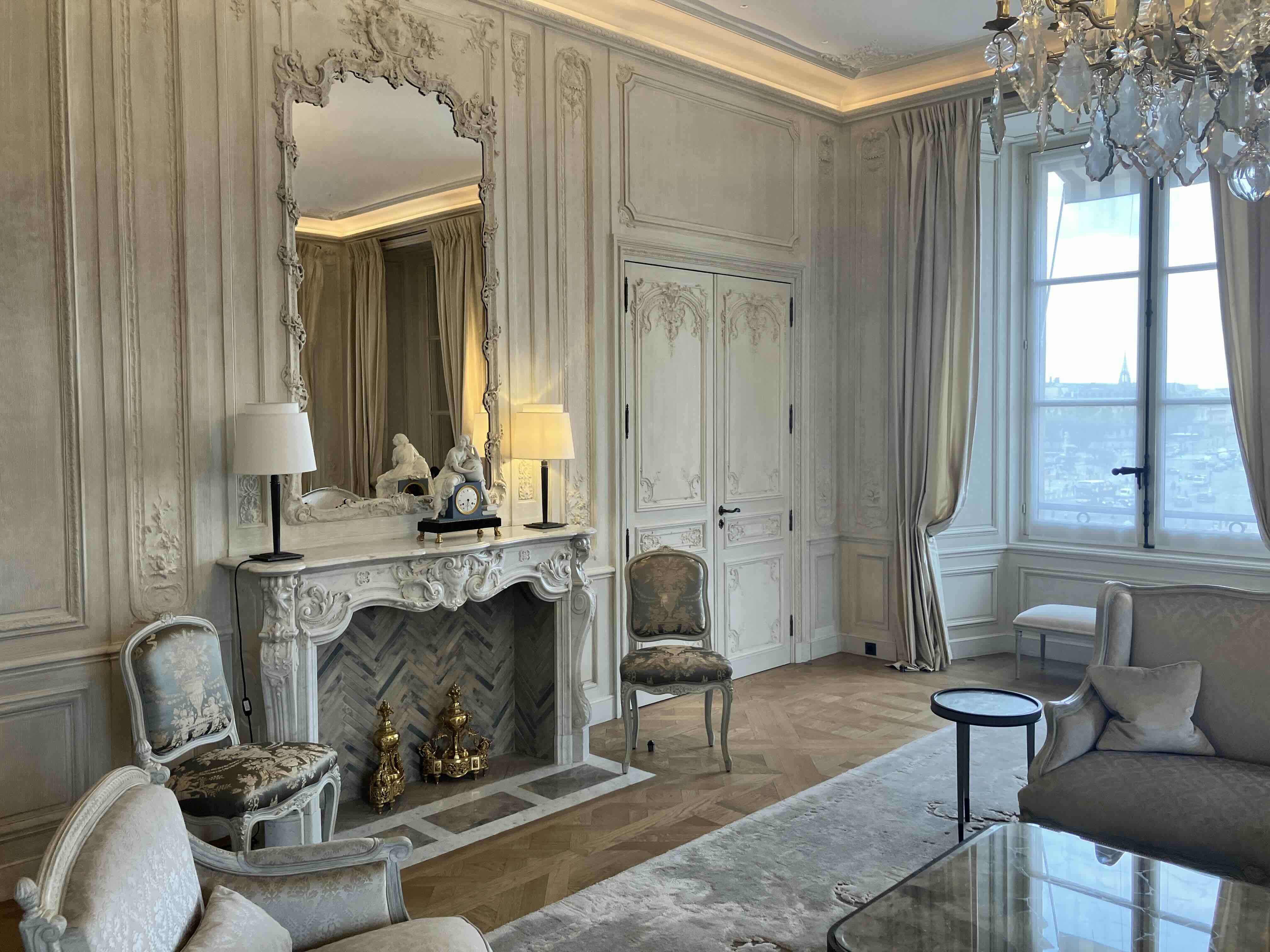
I had expected black and white because of Lagerfeld's association with Chanel. Instead, the rooms retained an extraordinary respect for the 18th century while being completely contemporary. The bathroom alone is remarkable. The bathtub story sounds almost impossible. The quarry in Italy had to be reopened, the floor had to be reinforced, and the enormous stone bathtub was brought through the window. It was then moved into position using ice and water to reduce the friction. I thought: this is insane. And then: this is amazing.
A Different Kind of Luxury
The restoration took four years before the hotel reopened in 2017. What struck us was how much space there was without losing the historical character. The approach is relatively minimalist, but the original French style remains very present. At the beginning of the lobby, near the entrance to the bar, two extraordinary statues immediately establish the age of the building. The façade and the earliest part of the hotel are protected, so they cannot simply be redesigned according to changing fashion. That matters at a place like this.
Some of the original woodwork from the former chapel is now preserved at the Metropolitan Museum of Art in New York. At the Crillon, other historic pieces remain part of the hotel itself. There is also something particularly pleasant about the smaller rooms and private corners. Because the building began as an aristocratic residence, it never feels entirely like a large hotel designed around public spaces. There are places where you can create your own temporary corner. For us, that is what makes the Crillon different. The history is not simply displayed. It is still sitting in the rooms.
Read more about this incredible property here:
DeSalvio Travel Review of Virtuoso Hotel property Hôtel de Crillon
DeSalvio Travel Gastronomy review of Hôtel de Crillon
DeSalvio Travel and its special Preferred Partner Amenities for Hotel de Crillon
If you are planning a stay in Paris and want to experience the city through its music, art, history and extraordinary hotels, we can help create an itinerary around the places that have a real story to tell. From the Hôtel de Crillon to private museums and musical experiences, we curate journeys that connect the places you stay with the culture around them. Contact us to begin planning your next European journey.

Robert Poortinga
Travel Booking Assistant
River cruise & Europe destination expert
Culinary and art travel specialist
Concert Pianist
_Black.png)