.svg)
Bergamo, Venice, and the Quiet Continuity of History
Bergamo feels deeply different from many Italian cities. Even though Milan lies close by geographically, the city still seems to look psychologically toward Venice. Our local guide, Sara, explained how the Bergamasque identity was shaped not only through roughly three centuries under Venetian rule, but also through difficult historical tensions with Milan. That Venetian connection remains visible everywhere, not only historically, but emotionally and aesthetically.
The cultural significance of Bergamo
What fascinated me most was understanding how culturally important Bergamo once became within the Venetian world. Venetian patrons travelled here specifically for art. Lorenzo Lotto and Giovanni Battista Moroni transformed the city into a serious artistic centre. There is even the famous anecdote of Titian supposedly telling a client: “Why do you ask me to make your portrait if Moroni is in Bergamo?” Whether fully true or not, the story reveals the extraordinary artistic reputation the city once possessed.
Venetian refinement appears differently here than in Venice itself. Venice was a maritime republic, a harbour city shaped by centuries of international trade. Like all great port cities, it became a cultural melting pot. Bergamo feels more restrained, more grounded, and perhaps more deeply Northern Italian in character. While Venice absorbed influences from distant worlds through sea trade, Bergamo remained closer to land routes toward Switzerland and Germany. Here, refinement is more authentically Italian rather than the international melting pot of Venice.
The contrast between Città Alta and Città Bassa
This historical continuity becomes immediately visible in the architecture. The contrast between Città Alta and Città Bassa is one of the most extraordinary urban contrasts in Europe. Rising toward the old city truly feels like stepping back centuries. The churches, towers, defensive walls, stone streets, and Renaissance interiors create an atmosphere that feels remarkably untouched by modernity.
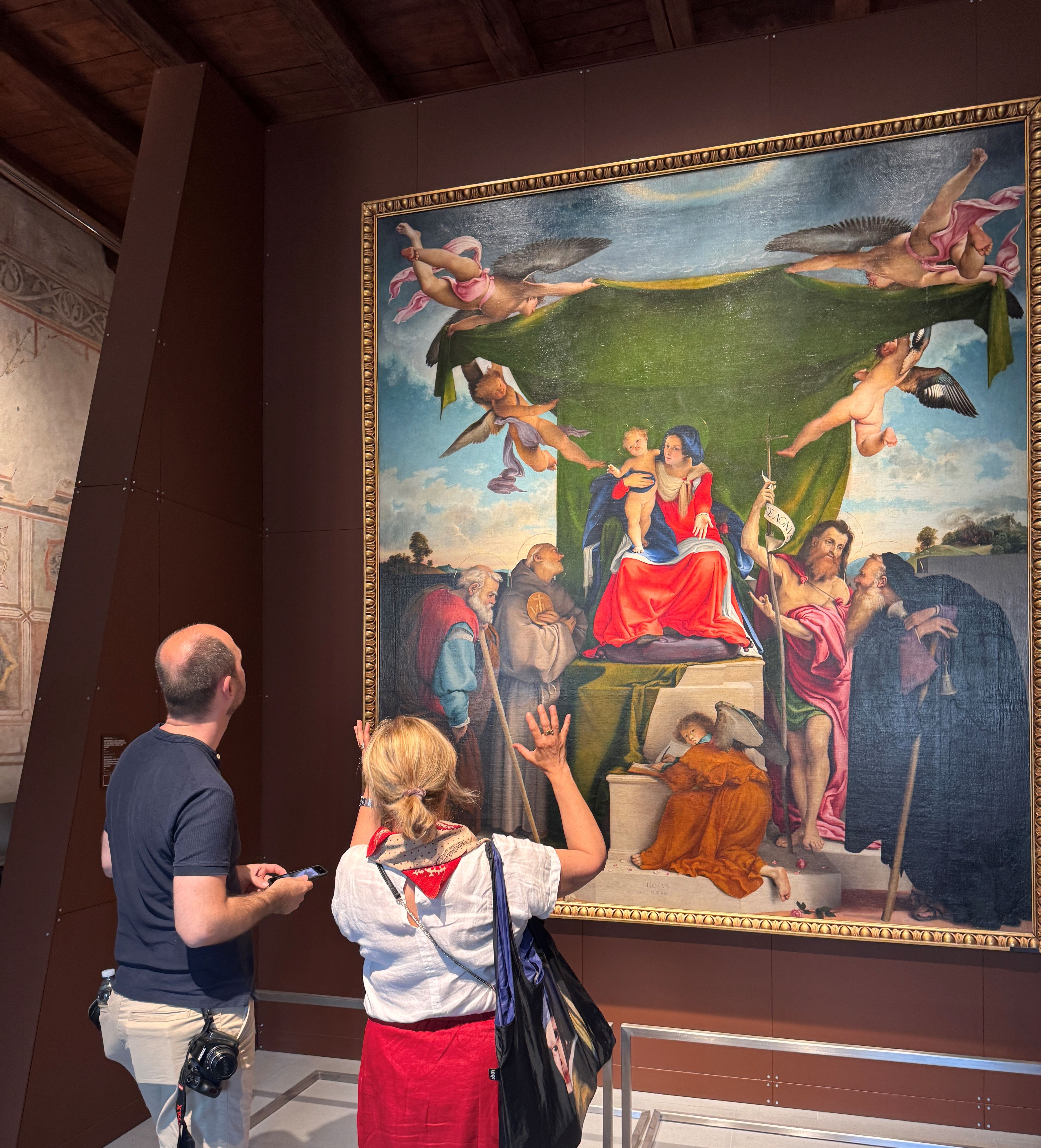
What struck me especially was how much authentic beauty survives precisely because it was never designed for mass tourism. During our visit to the Chiesa dei Santi Bartolomeo e Stefano, we found ourselves entirely alone inside an immense church filled with extraordinary art. Not only Lotto’s famous works, but countless paintings by artists largely forgotten outside Italy. Silence, old wood, incense, marble, shadow, centuries of devotion and craftsmanship; experiences like this feel increasingly rare in modern Europe.
It also made me realise how deeply Italy still lives alongside its historical continuity. Renaissance religious art inside active churches is not treated merely as museum culture. It still belongs naturally to the city itself. Our guide explained how many immense religious paintings were originally intended to communicate directly with ordinary people during periods of religious tension and Protestant expansion through Northern trade routes. People could not always read, but they could understand images. Art functioned not only aesthetically, but socially, spiritually, and politically.
The difference between experiencing Bergamo as a 20 and a mid-30 year old
Bergamo reveals the tension between preservation and modern commercialisation with unusual clarity. Città Alta remains remarkably protected, while Città Bassa absorbs much of contemporary life and international influence. Yet unlike many globally famous destinations, Bergamo still feels deeply local. Traditional gastronomy, craftsmanship, cafés, wine culture, and everyday rhythms remain intact.
What changed my experience most profoundly this time was exploring the city together with a local art historian. Previously, when I studied here for a year, Bergamo had impressed me through atmosphere, gastronomy, walks, and the simple joy of being in Italy. But understanding the historical relationships between artists, patrons, politics, religion, and trade transformed the city into something far deeper. Suddenly Bergamo was no longer simply beautiful. It became intellectually alive.
That is in my opinion what makes Bergamo so important today. It remind us that culture is not built through spectacle or commercial excess, but through centuries of accumulated refinement, memory, craftsmanship, faith, and artistic patronage. Bergamo does not overwhelm through grandeur. It persuades quietly through integrity.

Discover the Stories Behind Italy's Greatest Cities
Travel beyond the landmarks with expert local guides and thoughtfully crafted itineraries that bring Italy's history, art, and culture to life.

Robert Poortinga
Travel Booking Assistant
River cruise & Europe destination expert
Culinary and art travel specialist
Concert Pianist
_Black.png)